Friday, August 10, 2012

His Eminence Reflects Fear

Earlier this month, Bishop Blase J. Cupich of the Spokane Diocese published a letter entitled Some Reflections on Referendum 74 in which he explains to parishioners why they should not support Referendum 74. 

After expressing concerns for such things as birth certificates listing Parent 1 and Progenitor B, he closes with this:  

In sum, we are facing a decision about making a major shift in an institution that serves as the foundation stone of society. I would argue that this is not about granting equality to same sex couples, but of changing the identity of marriage. The church raises these concerns and objections to Referendum 74, not to impose its definition on marriage or determine who can or cannot be married. Neither the church nor the state has an exclusive right to do either. Marriage existed either before the church or the state. It is written in our human nature. 

Bishop Cupich claims that the institution of marriage is the foundation stone of our society. If so, then our society is as shaky as a tower of jello. Go to the Center for Disease Control and Prevention site and check the marriage and divorce reports for the states and compare the states that report for both. You'll find that almost half of all marriages end in divorce. 

From the National Violence Against Women Survey we learn that intimate partner violence is pervasive in our society. Nearly 25 percent of surveyed women and 6 percent of the men said they were raped and/or physically assaulted by a current or former spouse. Applied to the country and we have approximately 4.8 million intimate partner rapes and physical assaults perpetrated against U.S. women annually, and approximately 2.9 million intimate partner physical assaults committed against U.S. men. The church would have better standing opposing same-sex marriage if they claimed it was to protect partners from domestic violence.

What the bishop calls a foundation stone of society, if it truly is one, has been cracked and crumbling for a long time. And yet society perseveres.

Bishop Cupich expressed a concern that the referendum is about changing the identity of marriage. He states that neither the church nor state has an exclusive right to determine who can or cannot be married and yet by arguing for "traditional marriages of one man and one woman" that is precisely what the church is doing. 

Marriage did exist before the church and state, but not always as the so-called traditional marriage of one man and one woman. The bible is replete with inconsistencies regarding what he refers to as traditional marriage. 

He claims marriage is written in our human nature, but far be it from me to understand how a religious leader who must avoid that part of human nature can be in the best position to explain that.

In sum, Bishop Cupich's main concern is for "a major shift in an institution that serves as the foundation stone of society" and yet he is unable to provide evidence of such a shift in states and countries where same sex marriage is legal. It's been in effect for eight years in Massachusetts. It's been in effect for nine years in our northern neighbor of British Columbia. Society is still just as strong and functioning there as before.

Bishop Cupich would argue that Referendum 74 is not about granting equal rights to same sex couples--and he would lose. His reflections are a polite and civil expression of intolerance. If same-sex marriage is allowed in Washington, the Catholic Church will be free to claim it loves the sinner and can continue refusing to recognize or perform same sex marriages. And that is what the church fears--having its intolerance highlighted again and again as members of its parishes question why their son, daughter, brother, sister, etc., must be excluded.

Marriage by itself is not the foundation of society, but relationships are. How we treat our loved ones, our friends, our neighbors, and strangers plays a far greater role in the strength of our society than the institution of marriage.

Thursday, August 9, 2012

Scream Loud And Point

Congresswoman Cathy McMorris Rodgers today made the following statement on President Obama’s dismantling of bipartisan welfare reforms:

Welfare reform is an example of bipartisanship at its finest, with Republicans and Democrats coming together to solve a problem that had plagued our country for decades. It was among the most significant reform efforts of our lifetime. Barack Obama opposed bipartisan welfare reform and now, as president, he is moving to undo one of its central components. By making an end run around Congress and taking this ill-advised, unilateral action, President Obama has shown that he doesn’t have the popular support to gut welfare reform through the legislative process – and that he doesn’t seem to care.

How exactly is President Obama dismantling welfare reforms? If you, unlike our fair congresswoman, were to read the memo from the Department of Health and Human Services for yourself you would learn that this is not a change to the national welfare system. 


HHS is issuing this information memorandum to notify states of the Secretary’s willingness to exercise her waiver authority under section 1115 of the Social Security Act to allow states to test alternative and innovative strategies, policies, and procedures that are designed to improve employment outcomes for needy families.

HHS is requesting pilot-program proposals. And there's more.

In providing for these demonstrations, HHS will hold states accountable by requiring both a federally-approved evaluation and interim performance targets that ensure an immediate focus on measurable outcomes.  States must develop evaluation plans that are sufficient to evaluate the effect of the proposed approach in furthering a TANF purpose as well as interim targets the state commits to achieve.  States that fail to meet interim outcome targets will be required to develop an improvement plan and can face termination of the waiver project.

HHS will measure the outcome of the pilot program and the state will either improve the program or be terminated if it's not working. That's exactly what the dismantling of welfare reform looks like--if your singular goal in life is to say and do everything and anything possible to limit Obama to a single term.

Tuesday, August 7, 2012

Watch Out For Angry Texting Women Drivers


Recently, in the online Interweb news, there was a report of a survey done on workers who drive to work and the road rage they've experienced. You can find all the news articles here. They're pretty much identical except for the photo showing either a man or woman making an angry gesture while driving.

I couldn't find the survey, which is a shame, but here's the original press release from Career Builder.

Check out the first sentence.


A new study from CareerBuilder shows workers may have more than heavy traffic to contend with on their way to work. Fifty-eight percent of workers who drive to work said they experience road rage at times while traveling to and from the office, similar to findings in 2006 when the study was last conducted.


I like how the first sentence makes it seem like this is a new or growing problem. Then the end of the second sentence informs us that things haven't changed much in six years. Go figure. But the key verbiage here is "experience road rage". Without seeing the survey and how the questions were worded, "experience road rage" could mean being on the giving end, the receiving end, or both. It's not that clear. Then it states that 9 percent of workers who drive to work have gotten into a fight with another commuter. I have to question a couple of things here because that's a lot of fighting going on around town. What time period are we talking about? Did they get in a fight during the survey period or any time in the last ten years? What exactly does a fight consist of in this context? Actual blows? A heated exchange? Flipping the bird?


In the gender and age comparisons we're told:


Women were more apt to feel road age – 61 percent compared to 56 percent of men. In terms of age groups, workers ages 25 to 34 were the most likely to experience road at 68 percent while workers 55 and older were the least likely to experience it at 47 percent.


This is why I question the use of "experience" earlier because now they use "feel". Women are more apt to feel road rage. What does that mean exactly? If you become exasperated at a driver who swerves from lane to lane in front of you, are you feeling road rage? (Is that like feeling child rage when your kid quickly reaches for a glass of milk and knocks it over?) The remainder goes on with the use of "experience".


Next they mention texting.


Nearly one-in-four workers (24 percent) who drive to work reported they have been involved in an accident. While a variety of factors contribute to accidents, cell phone use can be a culprit. Three-in-ten workers (30 percent) admitted they have texted while driving to and from work.

Again, what's the time period involved here? One fourth of all drivers involved in an accident is a lot of accidents. Did the accident(s) occur during the survey period or some time in the last 10 years? And, yes, we all know that a variety of factors contribute to accidents, but without any data to support their position they're going with texting as a possible major cause. I get that texting distracts a driver, but a better question for a survey such as this would have been to ask whether they were involved in an accident while texting.


Last of all, the methodology.  With a pure probability sample of 3,892, one could say with a 95 percent probability that the overall results have a sampling error of +/-1.57 percentage points. Sampling error for data from sub-samples is higher and varies.

One could say that if one wanted to, but with the ambiguousness of this press release one couldn't say for sure what the sampling error is since what's being presented as the samnple is vague in the first place. There is something you can take from this survey that isn't mentioned.

Ride a bike.

Monday, August 6, 2012

Midnight Century Addendum


Now that I've had a good night's sleep... 

This ride is kick ass. It starts you off with a smooth 25 miles that gets you warmed up and feeling good about knocking out the first fourth quickly. That done, it throws you up and down the terrain, gives you thrilling and terrifying descents made more so as your speed overtakes what your light is able to reveal. This is no place for mushy brakes--if you use your brakes.

It lays out washboards in patterns that ensure you will hit the worst ones every time you dodge a set, shaking you so hard you'd swear you were trying to hold a paint shaking machine still. 

Deer and other animals pay you little attention as you pass by while they go about the business of staying alive, but you feel more of a connection with them when you're sitting in the dark in the middle of nowhere and a bunch of coyotes howling in the distance sound like they're coming closer. "I should get moving. I can finish this snack while I'm riding." You may not say it, but it's in the back if your mind.

The ascents in the dark attack your mind as much as your body. You can't see the top so you have no idea when you'll reach it. Your legs complain so your mind tries to allay their fears. "Almost there. Just a little more." The road levels out a bit and your legs breathe a sigh of relief. "See? It's okay now." Then you suddenly hit the steepest part and your legs cry in agony, "You lied to me!" Coming to several of the short climbs, the darkness misleads you as to how steep they are so you don't gear down. "This doesn't look like much and we've got some speed going," you tell your legs. Suddenly you're standing on the pedals chunk-chunking in a frantic attempt to shift down. Yeah, you'll be lying to your legs all night.

The peacefulness surrounding the dawn, while beautiful, can also chip away at your mindset. The lull and calm of the rising sun combined with being up through the night and the idea of a long rest clashes with the realization that you still have two or three or more hours to ride.

At just over the halfway point, you get a short reprieve from the dust, dirt, gravel and rocks and you're given a bit of smooth pavement. It's not a gift. It's the longest and steepest climb of the ride. Your legs ache and complain like never before and all you can do is suck it up. Following that you return to dirt roads where the gravel and the washboards seem deeper than ever. It's like it was intentional and you almost take it personally. You never stood so much while trying to pedal.

The last 20 miles you're mostly on pavement and your butt is so grateful. Smoothly cruising along the Cheney-Spangle highway and the Fish Lake Trail, your relief begins to convince you that this wasn't so bad. Then you reach the basalt infected, jarring interruption that is the unfinished section of Fish Lake Trail. It's your punishment for thinking you're almost done. One last slap down to remind you who the boss is. "This is the Midnight Century! I'm not done with you. How's your butt feelin', huh? That's what I thought. Now you can finish."

Rolling in to where you started hours before, the feelings of relief and accomplishment are overwhelming. And you don't mind being regarded as a lunatic by the early morning coffee drinkers whose curiosity compels them to ask what's going on. You just did the Midnight Century which is more that just something. 

But you have to admit, it still kicked your ass.

Sunday, August 5, 2012

Midnight Century

Some months I told my brother John that he should come over and we could do the Midnight Century together. (Foolishly) accepting the invitation, he drove over from Tacoma yesterday. We bought the necessary energy bars, energy blocks, energy packs, and fluids and loaded our bikes. I went with a trunk bag and John had a CamelBak backpack. I chose not to go with a backpack because my back gets too sweaty and I like to hang my camera on my back. 

For dinner I grilled a pork loin and made mashed Yukon Gold potatoes. The pork loin was succulent and the potatoes were creamy and tasted like they had a whole stick of real butter in them because they had a whole stick of real butter in them. We ate our calorie-laden dinner a little after 5:00 pm and then it was nap time. I managed to get in a three hour snooze. John didn't sleep as much but it didn't seem to matter later on.
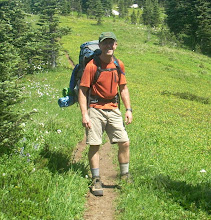
Representing Team Double Check, John and I wait outside the Elk. John Speare was kind enough to take the "before" photo for me. We look eager, energized, and positively motivated. And we match!
Milling about waiting for the start, a few riders made last minute preparations, which included loading beer into the bottle racks for one young man. Oh, to be 24 again, eh?
John Speare said he counted 48 at the start. Although (my brother) John and I were riding together, I was glad to see so many since that meant we might be able to join up with others. Misery loves company.
I guess it was 11:59, because suddenly riders started taking off. John and I joined in the chase and took off like slightly warmed cats. I think the scalded cats were three miles ahead of us in about two minutes.
We were making good time going through a relatively empty downtown until we hit the Convention Center. Something big had been going on and that something big was now over and a gazillion people were pouring out of the place. We had to walk our bikes. John led the way and a chain of bikes sliced through the huge crowd. We remounted once we got to the Centennial Trail and threaded our way through the last of the crowd.
John and I ended up with a young man who introduced himself as Jess. The three of us took turns leading our mini-pace line and we tore along Upriver Drive and the Centennial Trail. ("Tore" is a relative term since it felt like we were hauling ass but I couldn't say for sure because I don't do the bike computer thing.) Since the first 20 or so miles are paved and relatively flat I thought it wise to cover that quickly. We picked up a few others along the way. That's John leading the group above. We made good time but the group broke apart by the time we reached the border. John and I stopped for a few minutes to have a snack and Glen showed up. We rolled with him for a while. The climb up Idaho Road foreshadowed the rest of the ascents for me. I thought I had shifted to the small chain ring and scampered up the hill.
Arriving at the top I found Patrick changing a flat. Looking my bike over I discovered I was on the big chain ring. It wouldn't shift to the smaller one. I left it alone since I tend to make things worse when I work on them. (On a related note, I'm used to it because my so-called training consisted of commuting to and from work on the big chain ring. I'm having issues with the middle ring on my commuter. Why don't I get it fixed? It's the conundrum of not being able to ride my bike when it's in the shop vs riding my bike in a less than ideal state but I at least get to ride. Don't try to understand my stupidity. It is what it is.)

John and Glen arrived and we took off again. Our differences in stopping and eating patterns broke us up after several miles. Then a group you could refer to as the Brew Crew--taking the name from the jersey worn by the guy who loaded beer in his bottle racks--caught up with us. We alternated passing each other and riding together for about 20 miles.
At the top of Bruna Road we rested after the climb. The Brew Crew showed up and broke out the beer.  You know you're doing good if you're keeping up with the guy carrying the cooler of beer. And you're doing awesome if you're the guy carrying the cooler of beer.

After our descent we missed the turn onto the gated section of Dunn and ended up taking the long way to get back on course on Elder. Going through a set of rollers I didn't notice John passing me. After a bit I thought he had fallen back so I slowed down. After the rest of the Brew Crew passed by I only saw a couple of headlights behind me so I stopped to wait.
I took pictures of both riders as they went by and got worried about not seeing John. The sun was coming up and he might turn into a pumpkin. Coyotes might eat him. An elk might run him over. He might not live to pay me the money he owes me. You know, all those things a big brother worries about when he's worried about his little brother.
So I rode back until I reached a point where I knew John was with me. Patrick came down the road and said he hadn't seen anyone. At that point I knew John had gotten by me unnoticed and now he's probably wondering where I was. So I turned around again--and met John at the next intersection. He was worried he wouldn't see the money I owe him. What a guy.
Now John and I alternated with Patrick for the remainder of the ride. Patrick was good enough to keep us on course at a couple of key points. It's great when veterans familiar with the course help us newbies.

For the climb up Spangle Creek Road I manually put the chain on the smaller chain ring. It was much more manageable that way. The last 25 miles were pretty much a blur. I was ready to finish up. John was pretty tired but he gamely hung on as I pulled for much of the Fish Lake Trail.
John Speare recorded our finish time at 8:24 am and kindly took the "after" photo for us. We look tired, dirty, and ready to crash. We topped off our accomplishment with a deservedly huge breakfast at Dolly's Cafe. This was John's longest ride ever. Between the missed turn and the backtracking I figure we made the ride a true century. He admits he didn't train for it but he did great. We already have it on the calendar for next year.

Thursday, August 2, 2012

It's An Election Year

Cathy McMorris Rodgers' statement on the House's vote on H.R. 8, the Job Protection and Recession Prevention Act of 2012, extending the Bush tax cuts for another year.


“At a time when America is suffering through the worst economy since the Great Depression, I couldn’t think of a worse idea than raising taxes on any American,” said Rep. McMorris Rodgers.  “President Obama’s plan to raise taxes is a job killer, and House Republicans are determined to stop it. The bill we passed today will extend the current tax rates for all Americans, providing much-needed tax certainty.  By removing the threat of ‘taxmageddon,’ our bill will bolster America’s economy and create jobs.”  


Because the tax cuts, which have been in effect for over a decade, have done nothing to create jobs. But they have increased the burden of providing government revenue on the poor and increased the burden of maintaining wealth on the wealthy. So...yeah...that, um...evens out.


Because everybody hates taxes and if you keep reminding them then they won't think about the consequences of having low taxes. See above paragraph.


Because, for Cathy McMorris Rodgers and her party, uncertainty should only apply to whether or not the government can even run--except for the parts that bomb and shoot people.